headerphoto
Rowing Primer

Appraising a crew is perhaps the most difficult role that the expert has to play in sports. However, according to rowing experts, four major factors determine the run of a shell. These are: timing, form, power and conditioning.

Naturally, an excellent run, the distance a shell is propelled by one stroke cycle, is the effect sought by all crew coaches. So the first thing to perceive is whether a crew makes its shell move, that is, whether it has a good or a poor run.

Coaches will say that there are a lot of good crews, but many of them row differently, that is, their form varies. However, they all agree that the good crews have excellent timing. If the crew's timing is off, the boat won't run.

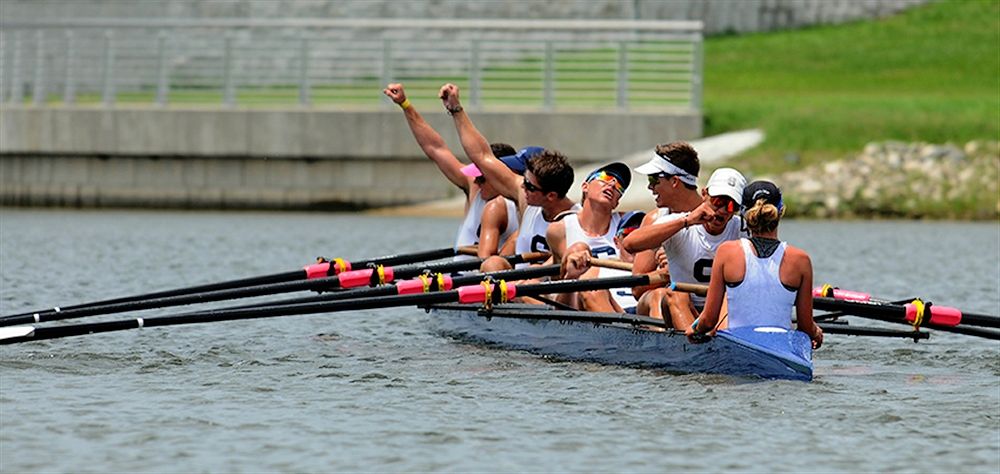
Look and see if all eight hit the catch together? That is, do their blades all enter the water together? Also, watch the bodies of the crew - see if they all move in unison, or if there is a break. The former naturally, spells results while a lack of uniformity means additional check, therefore retarding the run.

All good crews have power and drive, for it takes a certain amount of horsepower to move a giving weight through water, and of course, the athletes must be in top physical condition in order to keep their timing and form and power for the entire race.

Crew coaches look for tall athletes, for they can apply additional leverage, get a longer reach. However, size is not everything, especially if the individual doesn't have other prerequisites - timing, form, power and condition.

Anatomy of Rowing

Single

Boat Stats
Length - 8.280 m
Width - 0.280 m
Depth - 0.170 m
Weight - 14.5 kg

Pair

Boat Stats
Length - 10.000 m
Width - 0.383 m
Depth - 0.195 m
Weight - 28 kg

Double

Boat Stats
Length - 10.000 m
Width - 0.383 m
Depth - 0.195 m
Weight - 28 kg

Cox/Four

Boat Stats
Length - 12.900 m
Width - 0.490 m
Depth - 0.250 m
Weight - 59 kg

Quad/Convertible

Boat Stats
Length - 12.900 m
Width - 0.484 m
Depth - 0.225 m
Weight - 61 kg

Eight

Boat Stats
Length - 17.600 m
Width - 0.590 m
Depth - 0.285 m
Weight - 110 kg

The Ultimate Sport

The boats for competition were traditionally made from wood, but are mostly fabricated from carbon fibre and plastic (ie. Kevlar).

Rowing shells are .280 meters to .590 meters wide and 8.280 meters to 17.600 meters long. A small fin is fitted at the bottom for stability. A rudder is attached to the fin or the stern (except for sculling boats). A white ball is attached to the bow (called a bow ball for safety measure, photofinish). A washboard prevents waves splashing aboard. Seats are fitted with wheels which slide on runners, or tracks.

Oars are hollow to reduce weight, attached to the boat by adjustable out riggers. Size and shape of the oars is unrestricted, the average length of a sweep oar being 3.81 meters and of a scull being 2.98 meters.

There are six Olympic types of boats, of which three are for sweep-oared rowing in which the rower uses one oar with both hands and three are for sculling in which two oars are used, one in each hand.

The sculling boats are single scull, double scull, and quadruple scull, the sweep oared events are straight pair, straight four and eight. In the eight there is a coxswain who sits in the stern or lies in the bow of the boat.


Latest News


Sarasota Crew Rowers Compete Nationally and Inter

Carli Goldberg Competes in the 2010 World Rowing Junior Championships in Czech Republic Hunter Leeming Wins Gold in Men’s 4x at the CanAmMex Regatta McKayla Taaffe Wins Gold Medal at Independence Day Regatta Ryan Anderson Among Only 35 Nationally to Att...

     more

Sarasota Crew Rower Carli Goldberg Wins Silver at 2010

August 11, 2010 / Sarasota, FL: Sarasota Crew rower Carli Goldberg, a member of the US Women’s Junior National Team won the second-place Silver Medal in the Women’s 8+ race at the 2010 World Rowing Junior Championships held in Racice (near Prague) in the ...

     more